
flwr-trees: Federated Learning for Tree Ensembles
Links: PyPI · GitHub · pip install flwr-trees · License: Apache-2.0
Motivation
Tree ensembles remain the strongest models for tabular data, including clinical and financial records that often cannot leave the institution that holds them. Most federated learning tooling, however, targets neural networks, and federating tree models usually means writing a separate client–server script for each experiment. flwr-trees makes federated tree models usable as ordinary scikit-learn estimators.
Design
- scikit-learn compatibility. The library has eight estimators: Random Forest, XGBoost, gradient-boosted trees and histogram-RF, each as a classifier and as a regressor. All of them implement the
BaseEstimatorcontract and pass scikit-learn’scheck_estimator(). They therefore work insidePipeline,GridSearchCVand cross-validation without modification. - Three aggregation strategies:
FedForestBagging: each client trains trees locally, and the server pools them into one forest.FedForestCyclic: an XGBoost booster is passed round-robin between clients, each adding boosting rounds on its own data.FedHistogramAggregation: the main methodological contribution. In the first round, clients send per-feature split histograms instead of fitted trees. The server builds global split thresholds from these histograms, and clients then train with the shared thresholds.
- Experimental controls. The library supports Dirichlet non-IID partitioning (parameter α), client-dropout simulation, differential-privacy hooks (Laplace noise on histograms, Gaussian noise on leaf values) and CUDA support for XGBoost.
- Memory. A disk-backed tree store writes fitted ensemble members to disk and loads them lazily during evaluation, so memory use does not grow with ensemble size.
- Engineering. The test suite has 171 tests, run by continuous integration on GitHub Actions.
Usage
from flwr_trees import FederatedHistogramRFClassifier

clf = FederatedHistogramRFClassifier(
    n_estimators=50, n_clients=10, n_rounds=3,
    n_bins=32, iid=False, alpha=0.5,
    use_flower=True, random_state=42,
)
clf.fit(X_train, y_train)
print(clf.score(X_test, y_test))

# Inspect communication cost
print(clf.strategy_.bytes_sent_per_round)    # [histogram_bytes, tree_bytes, ...]
print(clf.strategy_.bytes_saved_vs_bagging)  # savings vs standard bagging
Results
Benchmark settings: 5 clients, 20 trees, 3 rounds, 32 histogram bins. The comparison is the size of the first-round upload under histogram aggregation versus standard bagging.
| Dataset | Round-1 payload saving | Accuracy (bagging → histogram) |
|---|---|---|
| Breast Cancer (IID) | 45.2% | 0.974 → 0.965 |
| Synthetic (IID) | 82.8% | 0.910 → 0.880 |
| Synthetic (non-IID, α = 0.3) | 80.6% | 0.665 → 0.700 |
| Adult (census income) | 99.8% (108 KB vs. 48 MB) | — |
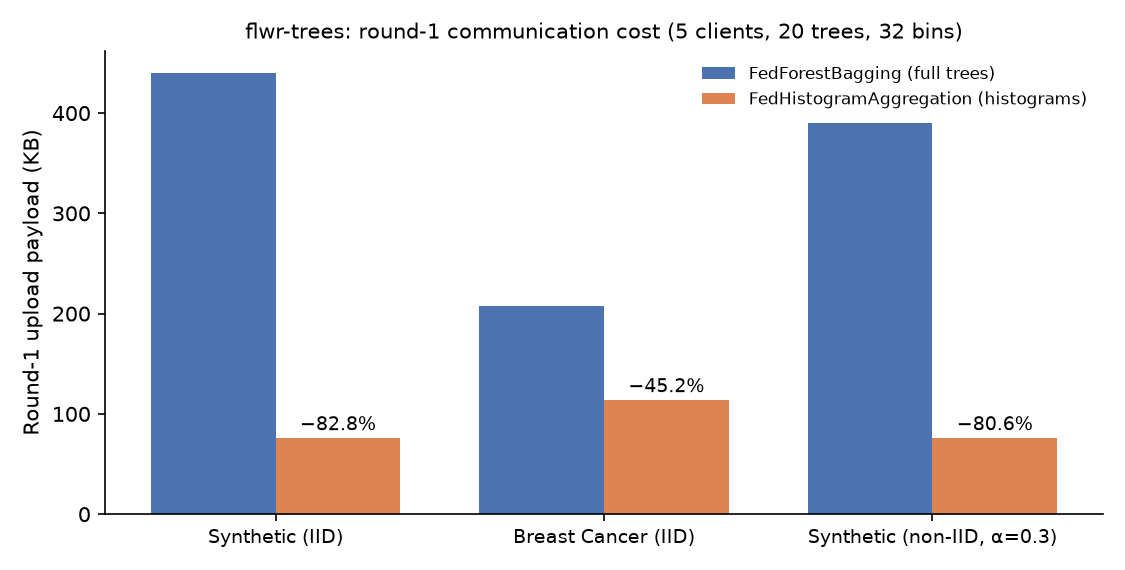
Figure. First-round upload size per strategy. Data: benchmarks/results.json in the repository.